DAS BUBO
Books Of Considerable Length.
In every great museum the story is arranged at eye level. Kings, saints, merchants and martyrs, hung at the height of an average standing adult, because that is where the labels go and that is where the lighting is aimed. It is a sensible way to hang a wall. It has also quietly decided, for about four hundred years, what visitors were allowed to notice.
Something else has been going on at the bottom edge of the canvas the whole time. A dog asleep under a banquet table while history is being written above him. A dog at the edge of a wedding portrait, entirely uninterested in the wedding. The painters kept putting them in. Art history kept leaving them out of the conversation.
Das Bubo is a small imprint built on that one observation. We take a subject that has always been explained from eye level and explain it again from about eight inches above the floor. The research is real. The reverence is real. The dachshund has opinions and is not shy about them.
It would be easy to file this under jokes about art. That isn't quite what it is. Every parody starts as admiration, because you cannot send up a thing you haven't looked at long enough to love. Putting a long dog in the middle of a Caravaggio does not make the Caravaggio smaller. It makes the light visible again, which is the one thing four centuries of reproduction have almost managed to wear away.
So the house has a single editorial rule and it isn't negotiable. We don't publish books that mock the thing they depict. We publish books that love it enough to make you look again.
The imprint's editorial director is Professor Sir Reginald von Barkenstein, F.R.S.A., formerly of the Royal Kennel Academy of Fine Arts. He does not exist. This has never once slowed him down.
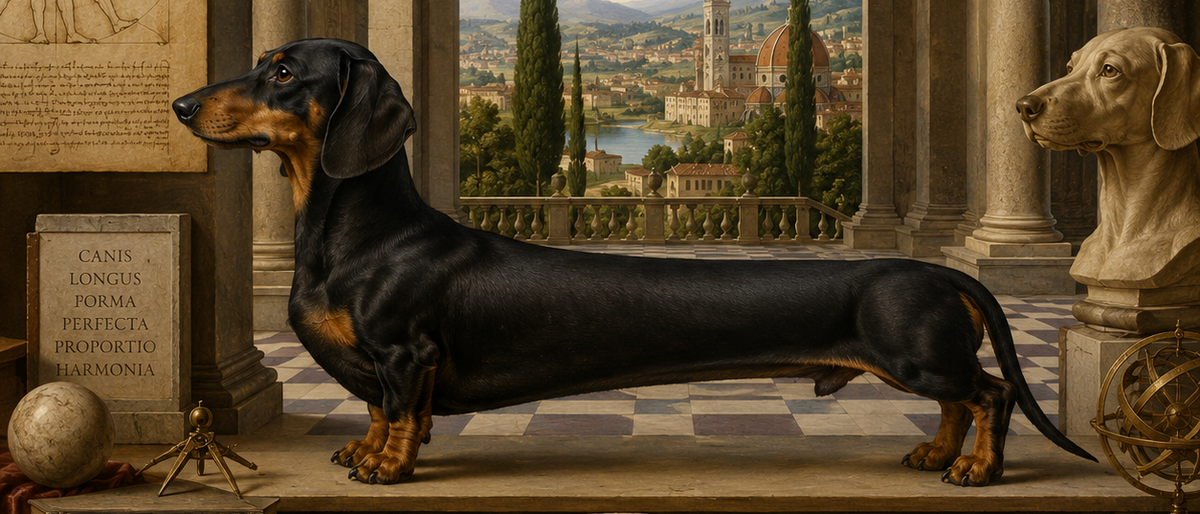
The first title is A Short History of Art, According to Dachshunds. Seventeen movements, from a Renaissance loggia in Tuscany to an empty white room containing one small dog and one unthrown ball, each re-examined by a creature who has never seriously entertained the possibility that the painting is about anyone else.
Until then, there's something worth trying on your next museum visit. Forget the label. Forget the date. Look at the lower edge of the canvas, in that narrow strip of territory nobody bothers to light.
Something is usually waiting down there.
Not the masterpiece. The dog underneath it.
M.