Essay
It's Not Scheduled
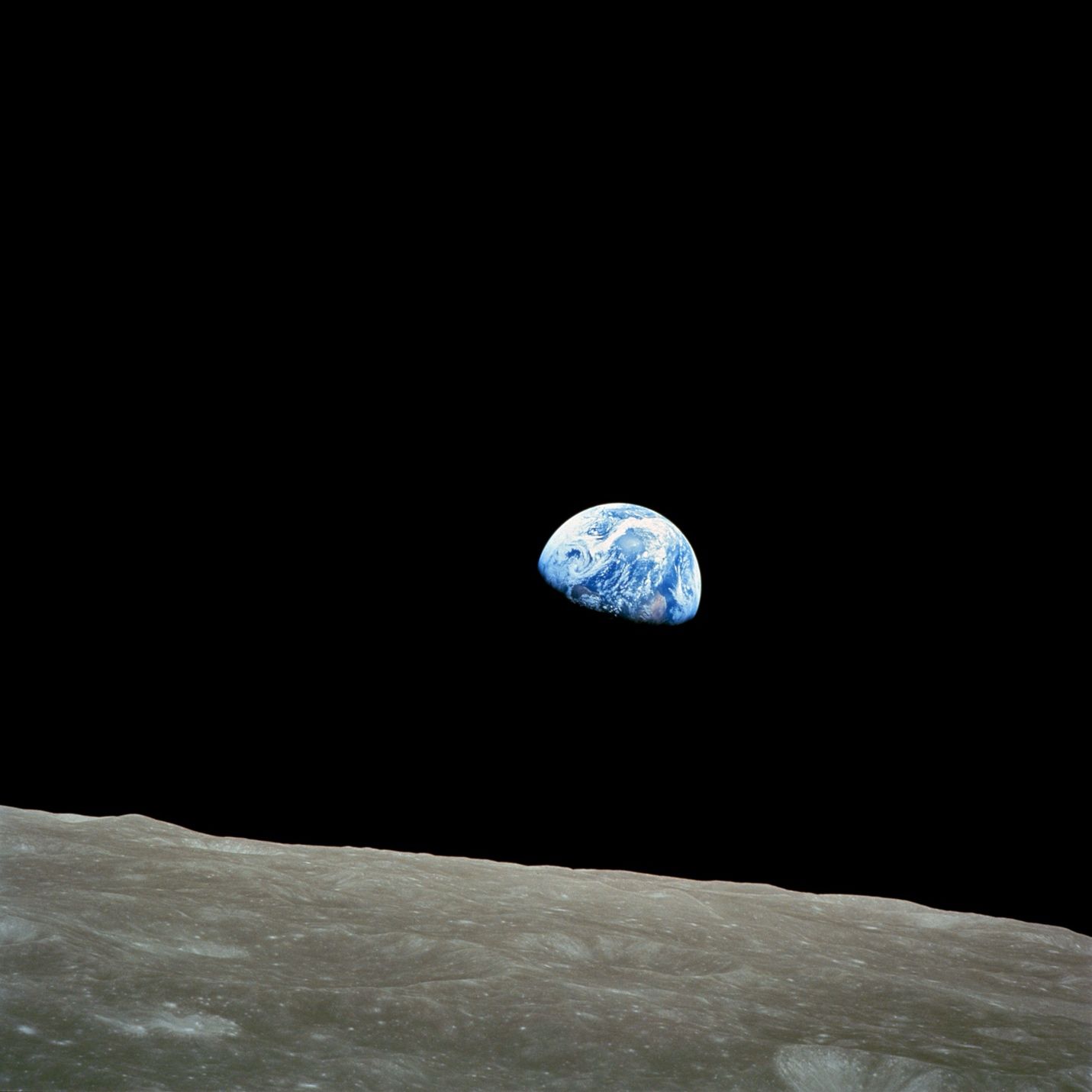
Everyone remembers the photograph. Fewer people remember the assignment.
In December 1968, the crew of Apollo 8 became the first human beings to orbit the Moon, and Bill Anders had a specific job: photograph the lunar surface. Craters, ridges, candidate landing sites for the missions that would follow. The flight plan listed his targets one by one, and Earth wasn’t one of them. Earth was the thing they had left behind, and nobody maps the place they’re leaving.
Then, on the fourth orbit, Frank Borman rolled the spacecraft, and the Earth came up over the lunar horizon. Small, blue, half in shadow, hanging over a dead grey landscape. The onboard recorder caught the moment exactly. “Oh my God, look at that picture over there! There’s the Earth coming up. Wow, is that pretty!” And then, from a crewmate, the line that gives the whole story away: “Hey, don’t take that, it’s not scheduled.”
He was joking. They took it anyway. There was a scramble for color film, and Anders made the photograph we now call Earthrise, the one that has been credited with helping inspire the modern environmental movement, the one that was on a postage stamp within the year, the one taken over their shoulders, almost by accident, of the thing they had supposedly finished with. Anders later said it himself: “We came all this way to explore the Moon, and the most important thing is that we discovered the Earth.”
There’s a detail I find quietly moving. For decades, even the crew misremembered who said what in those few seconds, and NASA’s own transcript had the two lines the wrong way round. Only when the tapes were reexamined, and the photographs matched frame by frame against the spacecraft’s position, did the record get settled: Anders spotted it first, and Borman was the one teasing him about the flight plan. Even memory had reorganized itself around the plan. The plan is that strong. It doesn’t just direct what we do. It edits what we believe happened.
We build our working lives the same way. Grant aims, five-year plans, job descriptions, protocols. A career is, in one sense, a flight plan: a list of what we already knew mattered before we left. And the list is necessary. Nobody drifts into lunar orbit. The discipline, the checklists, the thousands of scheduled frames are what put you in a position to see anything at all.
But a plan can only contain what was imaginable when it was written. That’s not a flaw in planning. It’s the definition of it.
I work in transplant research, and I’ve watched this pattern more times than I can count. The finding that redirects a program is rarely the primary endpoint. It’s the odd value in the margins of the data, the complication nobody was studying, the question a patient asks that no one on the protocol committee thought to. The work that turns out to matter has a habit of appearing in the window while everyone is photographing the target. And the usual response in that moment is some version of Borman’s joke. Don’t take that. It’s not on the aims page. It won’t count toward the milestone. It’s not scheduled.
The plan was never the mission. It was the vehicle. It got three men across a quarter million miles and into orbit, on time, alive. What it could not do was take the picture. That took something smaller and less fundable: a person willing to look up from the checklist, and a crew willing to spend a few frames of film on something that would earn them nothing on the debrief.
That’s the part I’d rescue from the story, because the grand version of this lesson is useless. You can’t schedule an Earthrise, and most unscheduled things are noise. Chasing every glint in the window is just a different way of never arriving. What you can do is modest. Keep a window. Look up when something enters it. Be willing to spend a frame, an hour, a weekend, one honest question on the thing that isn’t on the list. The maneuver that brought Earth into view was scheduled. The looking wasn’t.
Apollo 8 accomplished every one of its primary objectives, and almost none of that is remembered. What endures is the photograph of home, taken against a gentle protest that it wasn’t supposed to be taken at all.
Fly the plan. It’s how you get there. Just don’t confuse it with the reason you went.
Earthrise, Apollo 8, 24 December 1968. Photo: NASA/Bill Anders (AS08-14-2383)
Feedback, a suggestion, or just hello? Write to me at [email protected].
One email when something new goes up. Nothing else.
And a book for your trouble.