Essay
Same Line, Different Worlds
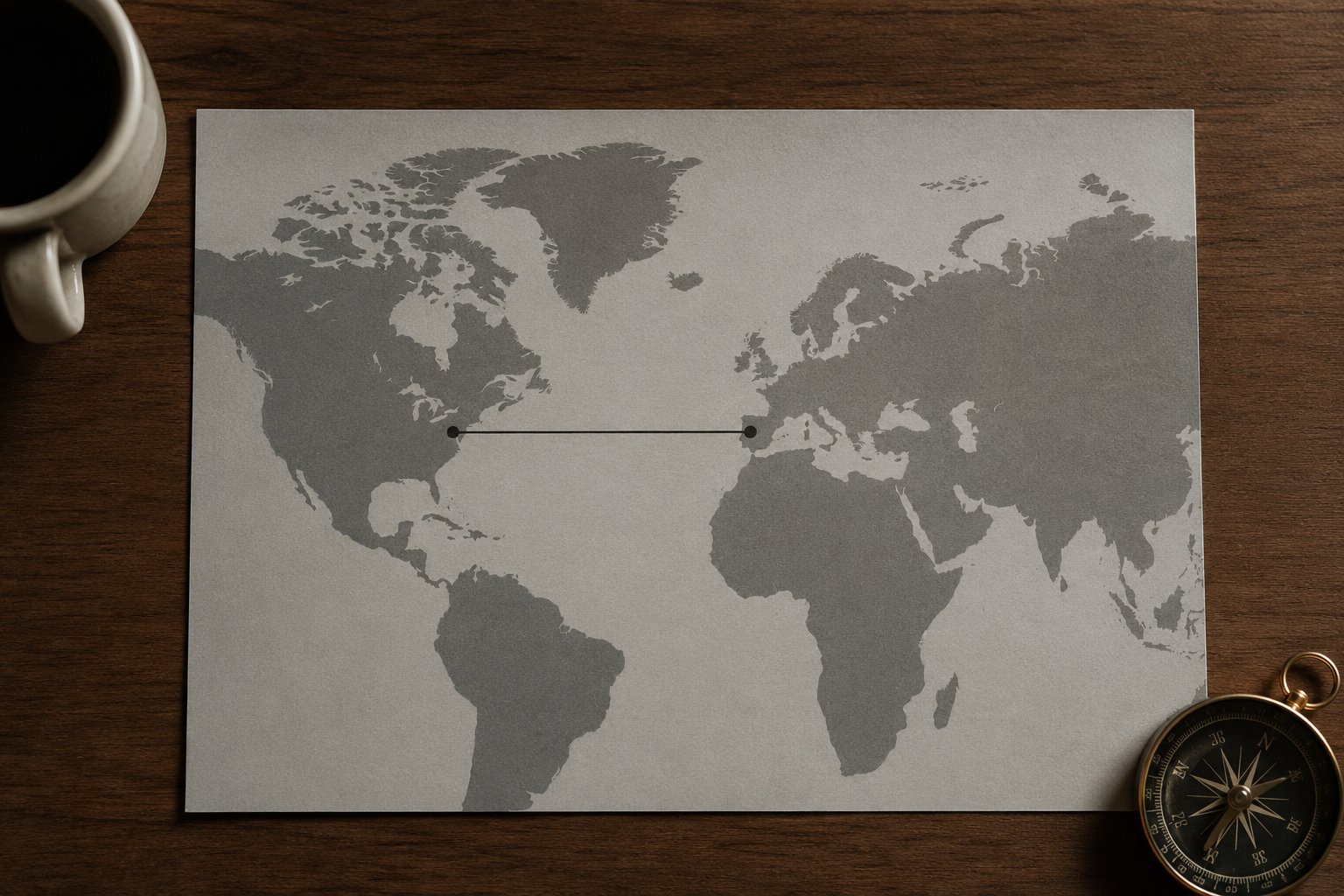
I grew up in the Porto region, near the 41st parallel, where the Atlantic sets the rhythm of everything. The haze over the Douro in the morning, the salt that gets into the washing, the winters that threaten all week and never quite bite. I work today in Cleveland, which sits on almost the same line. If you put a finger on the map at Porto and slide it west across the ocean without lifting it, you arrive more or less at my office.
It is a satisfying fact, the kind you tell at dinner. It is also slightly misleading, and the longer I have lived with it the more interesting the misleading part has become.
On paper, the two cities should be twins. The sun climbs to the same height over both of them at noon. The longest day of the year is the same length in each, and so is the shortest. Every equation that depends on latitude gives the same answer for Porto and for Cleveland. And then you step outside. One city is softened by an ocean that refuses to let the temperature do anything dramatic. The other is sharpened by a lake and a continent, and in January it does everything dramatic it can think of. The same light falls on both. It lands on completely different lives.
Cleveland has an unusual relationship with that line. When Connecticut kept its claim to a strip of land in what is now northern Ohio, the southern edge of that Western Reserve was drawn along the 41st parallel. In 1796 a surveying party went out to find it. Harriet Taylor Upton’s history of the Reserve, written in 1910, records that it took them seventeen days to run that first line through the woods, that their instruments disagreed with each other, and that when the whole survey was finished they were half a mile out. On the way back, she notes, the labourers showed less inclination to work, and the cooks became more irritable. It is the most honest account of mapping I have ever read. A line that looks perfect on the map was laid down by tired men in the wrong place, and nobody has quite agreed on it since.
I think everyone who has moved country knows a version of that half mile.
When you leave home, you carry a map in your head that says the new place and the old place should line up. Same job, same family, same person, a different address. Then you discover the gap. It’s in the bread, which is never right. It’s in the way people greet each other, which is either too much or not enough. It’s in the jokes that don’t translate and the silences that do. Portuguese has a word for the feeling that lives in that gap, and I won’t explain saudade here, because explaining it is the surest way to make it disappear. I’ll only say that it is not quite sadness. It is closer to keeping a place for something that is somewhere else.
The question people ask, kindly, is which one is home.
The honest answer is that the question assumes the line holds still. It doesn’t. After enough years, Porto becomes a place I visit and recognise with a small shock, the way you recognise your own handwriting on an old envelope. Cleveland becomes a place I live and still, occasionally, misread. I have friends on both sides who would each describe me slightly differently, and I suspect both descriptions are accurate. Two homes on one line is not a contradiction. It’s a latitude, and you learn to live along it rather than at one end.
My work has taught me the same thing from another direction. Transplantation is one of the most local things medicine does. An organ comes from one particular person, in one particular hospital, under one country’s laws and one system’s way of paying for things. And yet it is also one of the most global. A surgeon in Porto, a perfusionist in Cleveland, a coordinator in Barcelona or Istanbul, which sit on almost the same line, or in Wellington, on its mirror in the south, all work in different languages and under different constraints. They are all trying to do the same thing, which is to keep an organ well enough, for long enough, that it can give someone else more time.
The protocols change from one side of the ocean to the other. The paperwork changes, the regulations change, and nobody agrees on the coffee. What doesn’t change is the biology, the narrow window between recovery and loss, and the people standing on either side of it trying to widen it a little. I find that steadying. It means the gap between places is real, but it isn’t the whole story. Something runs straight through it.
That is what I have come to love about the 41st parallel. It doesn’t promise that Porto and Cleveland are the same. They aren’t, and the January wind off the lake will remind anyone who forgets. What it offers is smaller and more useful. It says that two places can share a line without sharing a life, and that a person can belong to both without having to choose. The surveyors were half a mile out, and the line still holds the map together.
Some mornings in Cleveland the light comes in low and pale through the window, and for a second it is the Douro light, the same angle and the same hour. Then the radiator knocks, and I am back. Both of those are home.
The account of the 1796 survey of the 41st parallel is from Harriet Taylor Upton, History of the Western Reserve (1910), chapter IV. A shorter version of this piece was first published on LinkedIn on June 20, 2026. Read the original post.
Feedback, a suggestion, or just hello? Write to me at [email protected].
One email when something new goes up. Nothing else.
And a book for your trouble.