Spielberg According to Dachshunds
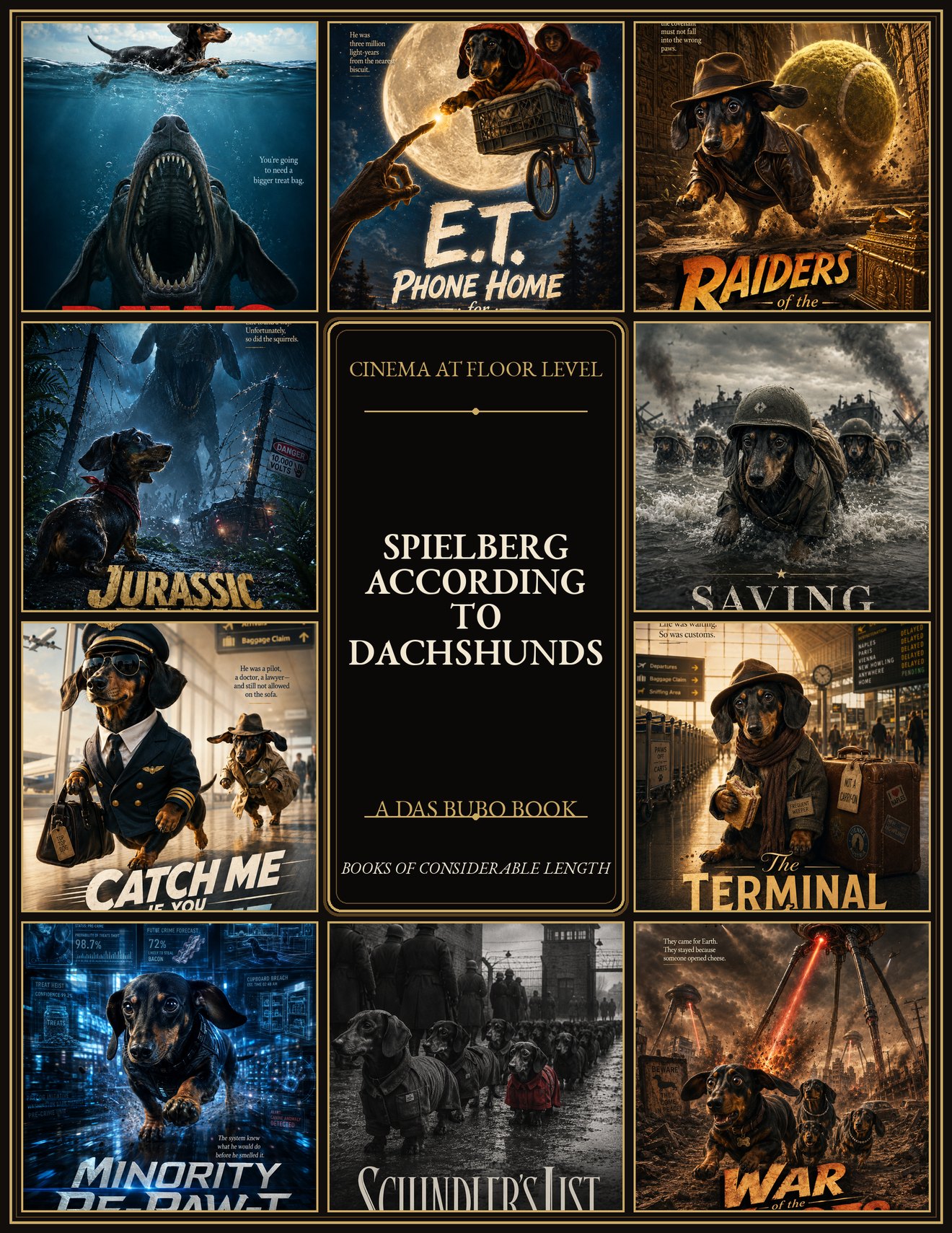
SPIELBERG ACCORDING TO DACHSHUNDS
A collection of films, memories, production histories, and extremely serious dogs.
A DAS BUBO PUBLICATION
Editorial direction by DAS BUBO
A DAS BUBO PUBLICATION
Concept, editorial direction, text, and design by DAS BUBO.
Copyright © 2026 DAS BUBO. All rights reserved.
No part of this publication may be reproduced, stored, transmitted, or distributed in any form or by any means without prior written permission from the copyright holder, except for brief quotations used in reviews, criticism, scholarship, or other uses permitted by law.
This publication is a work of artistic parody and affectionate reinterpretation. References to films, filmmakers, performances, characters, production histories, visual motifs, studios, and cultural figures are used for commentary, humour, criticism, and educational appreciation.
The underlying films, names, trademarks, and related intellectual property remain the property of their respective rights holders. This independent publication is not sponsored, authorized, or endorsed by Steven Spielberg, any studio, distributor, estate, or affiliated entity.
DAS BUBO · © 2026
EDITORIAL
By Professor Sir Reginald von Barkenstein, F.R.S.A.
Former Curator of the Royal Kennel Academy of Motion Pictures, Practical Wonder, and Upholstery
There comes a moment in every civilization when its cinema must be reconsidered. Not rejected, not corrected in the vulgar sense, and certainly not improved by committee, but viewed again from a more revealing altitude. In the case of Steven Spielberg, that altitude is approximately eight inches above the floor.
For more than half a century, audiences have entered Spielberg’s films expecting movement and discovered emotion; expecting monsters and found childhood; expecting machinery and encountered longing. The shark is terrifying, but the marriage is already sinking. The alien is miraculous, but the boy is lonely. The dinosaurs are magnificent, but the adults have confused scientific possibility with administrative competence. Spielberg understands, with unusual precision, that spectacle becomes memorable only when it presses against vulnerability.
The dachshund is therefore not an intruder into this cinema. He is a natural interpreter of it. No animal is better qualified to represent courage complicated by physical inconvenience, appetite complicated by ethics, or dignity complicated by a staircase. The dachshund approaches the unknown with the confidence of a creature who has never studied the briefing and does not intend to begin now. This is not merely comic temperament. It is classical screen presence.
The pages that follow do not replace Spielberg’s films with jokes. They approach them through parody as one approaches a great building through a side entrance: the perspective changes, the structure does not. A tennis ball becomes a boulder because Raiders of the Lost Ark is already a film about objects acquiring myth through velocity. The treat cupboard becomes a site of predictive policing because Minority Report is already concerned with the dangerous seduction of systems that know outcomes without understanding motives. The airport sandwich matters because The Terminal knows that civilization is often revealed by what it permits a stranded person to eat.
Certain films require a different register. Saving Private Ryan and Schindler’s List are included with deliberate restraint. In those pages the dachshund is not a punchline but a figure of vulnerability, loyalty, witness, and the individual life that refuses to disappear into mass history. Humour has limits, and affection proves itself partly by knowing where they are.
Elsewhere, however, one may proceed with confidence. Spielberg’s career contains an extraordinary number of dogs who have not yet been cast: the archaeologist who distrusts snakes but trusts momentum; the pilot who understands that a uniform is simply an argument with buttons; the immigrant traveler who occupies little floor space while generating a full constitutional crisis; the suburban family whose response to alien invasion is to run, together, with ears behind them.
This volume is thus part film history, part criticism, part collector’s cabinet, and part correction of a longstanding omission. It asks not whether Spielberg’s cinema can survive the dachshund, but whether it had been waiting for him all along. The evidence, once carefully sniffed, is overwhelming.
One final instruction: read slowly. Look closely. Admire the lighting. Respect the production design. And never assume that the dog in the pilot’s cap has completed the required training.
Professor Sir Reginald von Barkenstein, F.R.S.A.
Royal Kennel Academy of Motion Pictures
Autumn Screening Catalogue, 2026 (Revised Edition)
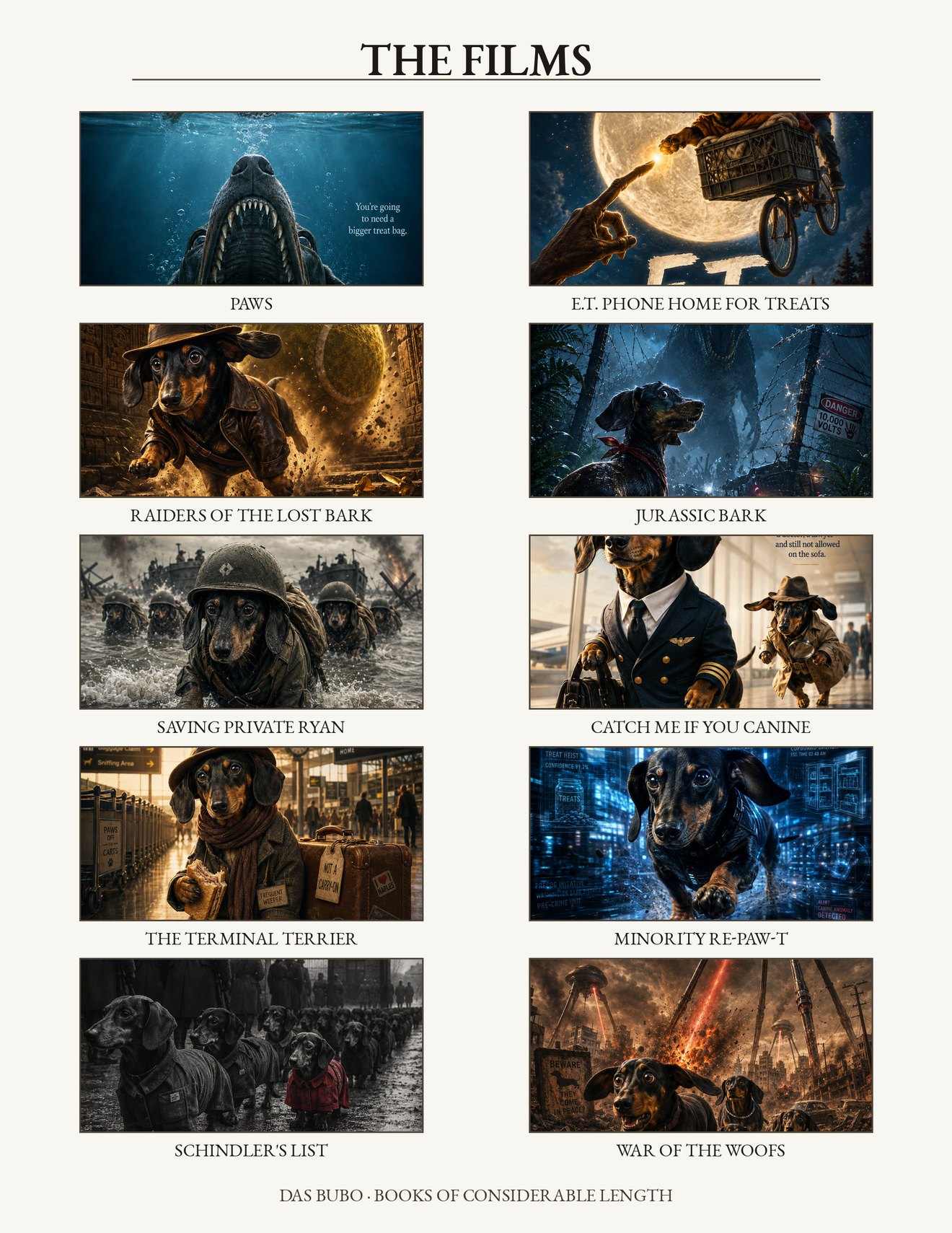
FILM No. 01
Paws
1975 · The summer the ocean learned suspense
Before Jaws, the sea in American movies was generally scenery: a glittering blue suggestion that somebody owned a convertible. After Jaws, it became a character, a suspect and, for several summers, an argument against swimming farther than one could stand. Steven Spielberg adapted Peter Benchley’s bestselling novel into something leaner and more elemental: a story about fear moving invisibly beneath ordinary life. Amity Island is not merely threatened by a shark. It is threatened by the civic instinct to keep the beaches open, the cash registers ringing and the unpleasant evidence politely offshore. In that sense, Jaws is as much a political comedy as a monster film, although the mayor’s blazer is the only creature in the picture more confident than the shark.
The production itself has become one of cinema’s great survival stories. Shooting on and around Martha’s Vineyard gave the film a convincing horizon but also delivered wind, tides, drifting boats and an ocean entirely uninterested in continuity. The full-size mechanical sharks repeatedly malfunctioned in salt water. This was catastrophic for the schedule and miraculous for the movie. Because the shark could not reliably appear, Spielberg had to suggest it: a yellow barrel tugged across the surface, a subjective camera gliding underwater, John Williams’s two-note warning advancing like fate with excellent rhythm. The monster’s absence created suspense more efficiently than its machinery could create a shark. It was the cinematic equivalent of a dachshund remaining absolutely silent in another room: proof not of innocence, but of advanced planning.
Spielberg also resisted filling the film with major stars because, as he later explained, the shark was meant to be the celebrity. Roy Scheider, Richard Dreyfuss and Robert Shaw consequently arrive not as icons but as sharply different human beings forced into the same inadequate boat. Brody is frightened of water, Hooper trusts knowledge and expensive equipment, Quint trusts experience and a personality assembled from rope, salt and old grievances. Their voyage on the Orca turns a public disaster into chamber drama. Verna Fields’s editing gives the film its exact nervous system, especially in the beach sequences, where glances, bodies and empty water become a geometry of dread. Williams’s score does not merely accompany the shark; it effectively gives the unseen animal an appointment calendar.
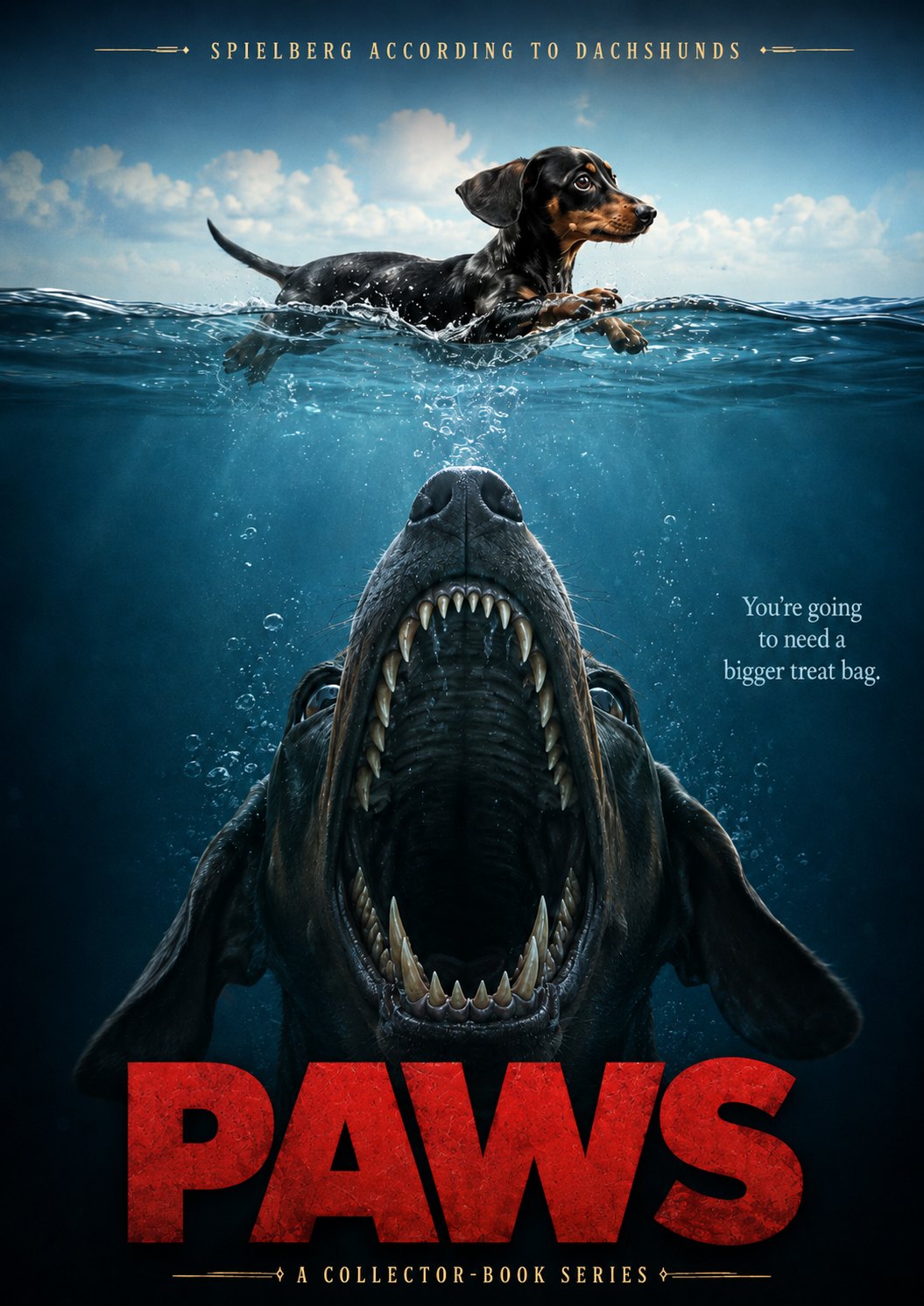
The film’s success helped establish the modern summer blockbuster: a wide release, coordinated national advertising and the sense that one movie could become a season. Yet the craftsmanship remains intimate. Spielberg’s gift is not simply making the shark large. It is making Brody’s dining table, the town meeting and the ferry crossing feel vulnerable before anyone reaches open water. Our dachshund version preserves that logic. The small swimmer above the surface is not foolish; he is merely confident in the ancient canine doctrine that danger applies chiefly to other households. Beneath him rises an appetite of impossible scale. This is Spielberg’s central joke and terror: ordinary creatures proceed with their day while something enormous has already entered the composition. The dachshund, naturally, assumes it has come about the treat bag.
Historical notes: AFI Catalog; Academy of Motion Picture Arts and Sciences, Jaws collection; AFI Movie Club.
FILM No. 02
E.T. Phone Home for Treats
1982 · A visitor from the stars, concealed under a blanket and family longing
E.T. begins with a visitor from another world and ends as one of cinema’s most precise accounts of childhood loneliness. Spielberg had already filled the sky with wonder in Close Encounters of the Third Kind, but here he brought the mystery down to suburban floor level, where bicycles lie in driveways, siblings negotiate alliances and adults are first encountered as shoes, keys and intrusive flashlights. The extraterrestrial is extraordinary chiefly because Elliott needs him. Their friendship gives physical form to the child’s wish that somebody, somewhere, might understand everything without requiring a well-structured explanation before bedtime.
The project emerged in conversations between Spielberg and producer Kathleen Kennedy before production on Raiders of the Lost Ark. Kennedy suggested Melissa Mathison, the screenwriter of The Black Stallion, while Mathison was visiting the Raiders company with Harrison Ford. She initially resisted the assignment, reportedly intending to stop writing, which is a charmingly inefficient way for one of the most beloved screenplays in American cinema to begin. Mathison’s script transformed Spielberg’s darker alien ideas into a domestic fable. Even Peter Coyote, who plays the government scientist known chiefly by his keys, had previously auditioned for Indiana Jones. In Spielberg’s universe, one may fail to obtain the fedora and still be promoted to concerned federal adulthood.
The creature designed by Carlo Rambaldi had to be strange enough to belong elsewhere and expressive enough to carry long stretches of silence. E.T. is neither conventionally cute nor aggressively monstrous. He resembles a botanist, an old philosopher and a well-used leather handbag who has unexpectedly learned affection. The film’s visual strategy protects that ambiguity. The camera often inhabits the children’s height; the suburban rooms seem enormous, adults arrive fragmentarily and Halloween becomes the one evening when an alien may move through public space without paperwork. John Williams’s score supplies the grandeur that the modest locations deliberately withhold. By the final bicycle flight, domestic geography has become mythic without losing its cul-de-sacs.
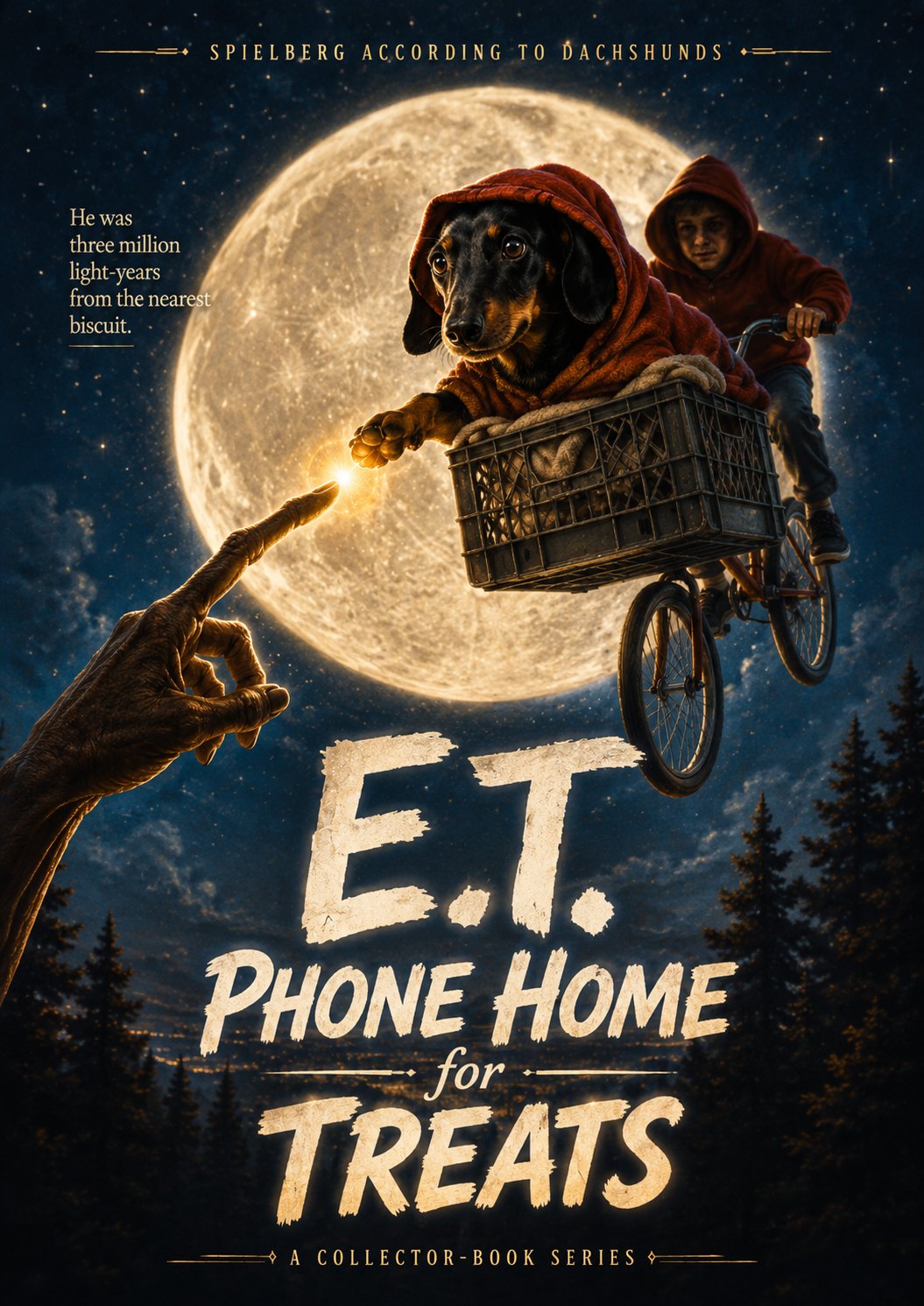
The film received nine Academy Award nominations and won four, including honors for its music, visual effects and sound. Yet its durability comes from details that spectacle cannot explain: Elliott drawing the blinds, Gertie teaching E.T. words, the children trying to keep a cosmic secret in a house where nobody can keep cereal private. Spielberg understood that the fantastic works best when it must coexist with clutter. Our dachshund passenger therefore belongs perfectly in the bicycle basket. Dachshunds already possess the physique of creatures designed by an imaginative extraterrestrial committee: elongated for reasons nobody will disclose, equipped with ears of ceremonial importance, and capable of communicating urgent sorrow through a single glance at an empty plate.
The treat in the title is not merely a snack. It is the dachshund translation of home: the smell by which belonging can be located across impossible distance. E.T. phones the stars because departure is necessary, but the film insists that separation need not erase attachment. A glowing fingertip, a remembered phrase and a red hood become enough. Spielberg’s sentiment is powerful because it is never cynical about the child’s scale of feeling. To an adult, the visitor is a biological event. To Elliott, he is a friend who must not be taken. To a dachshund, he is a guest who has survived interstellar travel and therefore may reasonably be carrying cheese.
Historical notes: AFI Catalog, E.T.: The Extra-Terrestrial; Academy of Motion Picture Arts and Sciences; 55th Academy Awards records.
FILM No. 03
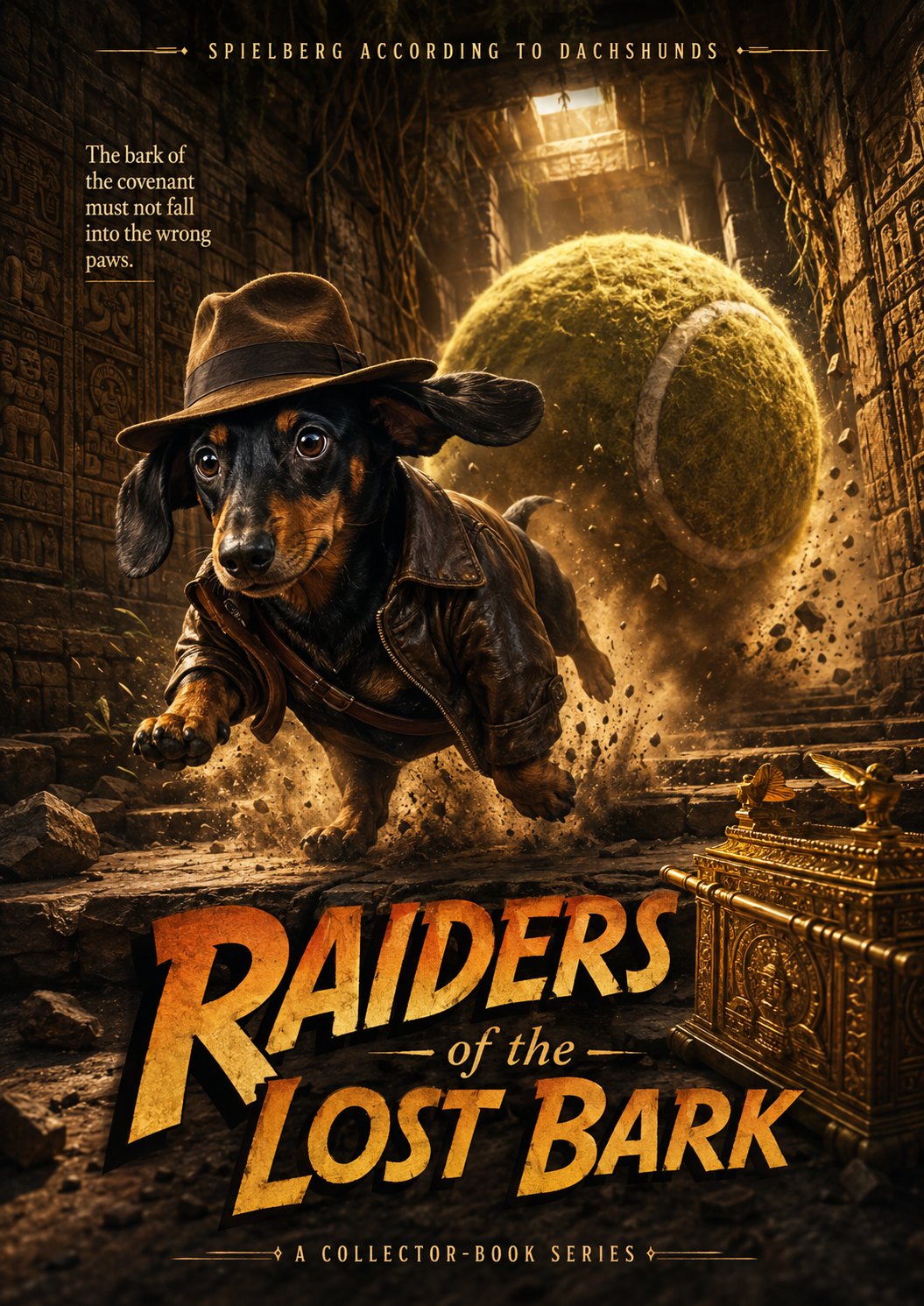
Raiders of the Lost Bark
1981 · Archaeology, velocity and the sacred authority of the fedora
Raiders of the Lost Ark was built from remembered fragments: Saturday matinee serials, cliff-hangers, jungle adventures, wartime villains and the childhood conviction that ancient temples were designed primarily to punish people who touched the wrong decorative object. George Lucas had conceived a hero called Indiana Smith in the early 1970s. During a week of recorded story conferences, Lucas, Spielberg and screenwriter Lawrence Kasdan developed the character and his adventures; the resulting transcript ran to roughly a hundred pages. Spielberg found “Smith” too ordinary, and “Jones” was adopted. A cinema legend was therefore improved by one of the smallest administrative decisions in screen history, the narrative equivalent of moving a dog’s name from “Buddy” to something that can be shouted across a continent.
Spielberg approached the material with extraordinary discipline. Raiders feels reckless, but its momentum is architectural. Every action creates the next difficulty: a stolen idol releases a boulder, an escape produces a pursuit, a victory on a truck immediately discovers another truck. Indiana Jones is heroic not because he controls events but because catastrophe repeatedly fails to complete the paperwork. Harrison Ford’s performance gives the character fatigue, irritation and the very useful expression of a man who has realized that scholarship does not usually include being dragged beneath moving vehicles.
The film’s visual identity was engineered with equal care. Costume designer Deborah Nadoolman shaped the fedora so Ford’s eyes remained visible and created leather jackets with an action pleat, allowing the whip arm to move freely. Multiple jackets were aged to look identical, because archaeology may be untidy but continuity is a jealous god. Douglas Slocombe’s photography gives the picture the texture of an illustrated adventure annual: amber light, black silhouettes, dust and faces cut into heroic planes. John Williams’s march announces that courage has entered the room, usually several seconds before common sense leaves it.
The great joke of Raiders is that Indy is both magnificent and perpetually inconvenienced. He hates snakes, loses the artifact, gets hit often and survives partly because villains insist on explaining themselves. This makes him ideal for dachshund translation. The breed shares his defining attributes: a low center of gravity, unreasonable confidence in tunnels and an absolute refusal to believe that an object placed on a pedestal belongs to somebody else. Our rolling boulder becomes a gigantic tennis ball, not because danger has been diminished, but because canine archaeology recognizes the tennis ball as an object of sacred and immediate pursuit. No ancient warning can compete with felt, bounce and the faint smell of the garden.
Raiders also clarified Spielberg’s mastery of popular form. He could make an audience understand geography instantly, build suspense from simple objects and move between terror and comedy without the joints showing. The Ark itself remains properly mysterious; the film does not treat the supernatural as a puzzle to be solved, but as a boundary arrogant men ignore. Indiana survives because, at the decisive moment, he knows not to look. This is unusually sophisticated behavior for an adventure hero and nearly impossible for a dachshund, an animal constitutionally required to inspect any forbidden cupboard. The Bark of the Covenant, therefore, must not fall into the wrong paws. It is difficult enough keeping it off the sofa.
Historical notes: AFI Catalog, Raiders of the Lost Ark; Academy costume-design guide; Academy collections.
FILM No. 04
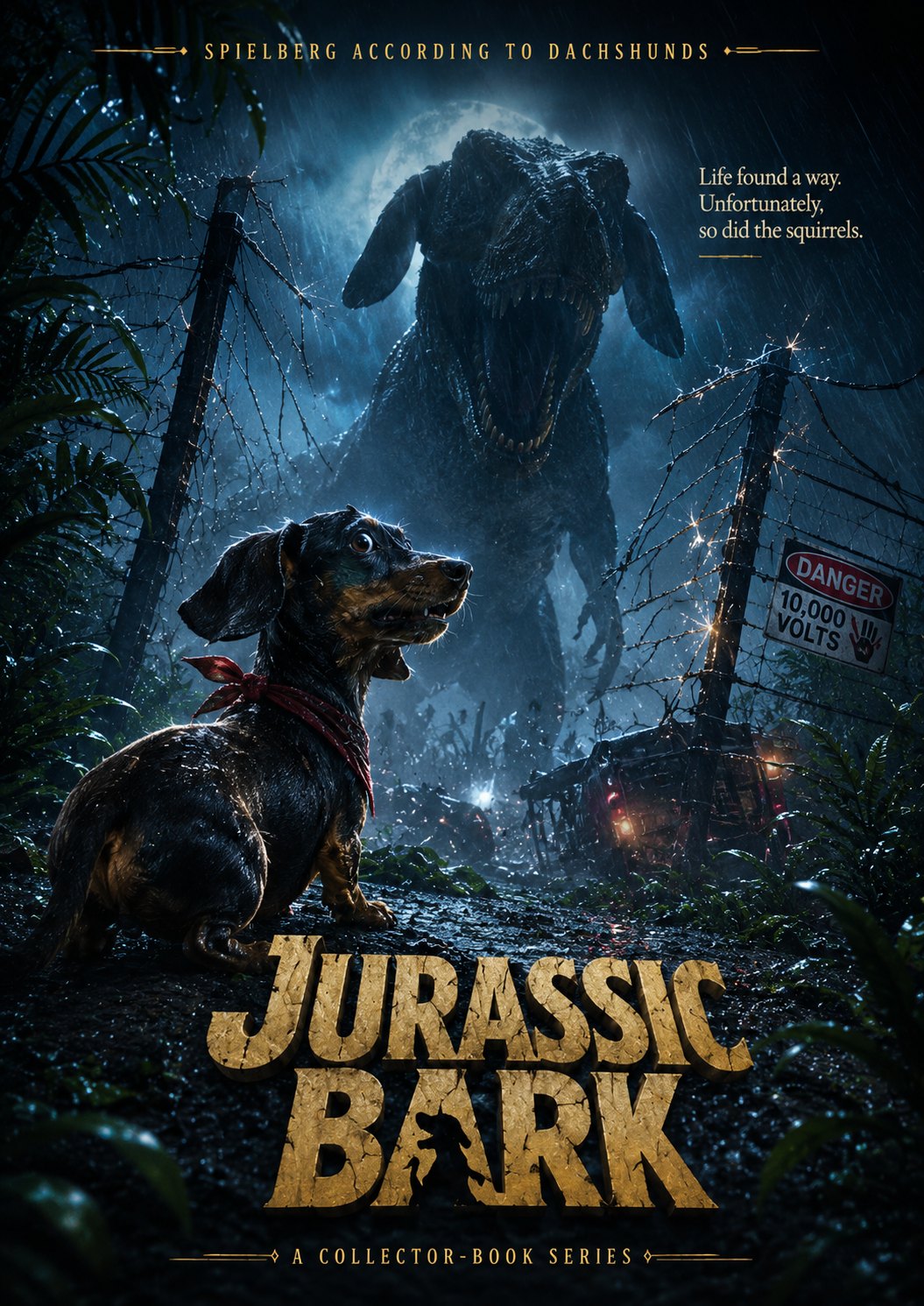
Jurassic Bark
1993 · When wonder escaped its enclosure and management blamed the weather
Jurassic Park begins with a commercial proposition so attractive that almost everybody ignores its philosophical content. John Hammond has resurrected dinosaurs and installed them in a theme park. Investors see a market, scientists see an ethical emergency, children see the greatest holiday ever devised and the dinosaurs, once consulted, see an unlocked buffet. Michael Crichton’s novel supplied the systems thinking: genetics, automation, finance and human vanity connected so tightly that one failure can travel through the entire enterprise. Spielberg preserved the caution but added awe. Before the park collapses, he allows us to believe in it.
That belief depended on a technical transition now regarded as a watershed in visual-effects history. The original plan relied heavily on established stop-motion and go-motion methods, with Phil Tippett leading creature animation. Tests from Industrial Light & Magic demonstrated that computer-generated dinosaurs could move with unprecedented fluidity. Rather than discarding the old craft, the production combined disciplines: Tippett’s understanding of animal movement informed the digital animation, while Stan Winston’s full-scale animatronics gave actors enormous physical creatures to touch, fear and occasionally stand beneath in rain. The result did not announce one technique as the future. It made several techniques collaborate so well that the audience forgot to ask which part was real.
The Academy recognized the film with Oscars for visual effects, sound and sound-effects editing. Its deeper achievement, however, is dramaturgical. Spielberg introduces the dinosaurs as characters, not demonstrations. The first brachiosaurus is framed through human astonishment. The sick triceratops has weight and breath. The tyrannosaur arrives after a long lesson in absence: a vibrating cup, a stopped vehicle, a fence that has become purely decorative. The kitchen sequence turns polished metal, hanging ladles and a child’s reflected image into instruments of suspense. Clever girls and clever raptors meet on equal terms.
A lesser-known marvel of timing surrounds the film’s post-production. Spielberg began shooting Schindler’s List in Poland while Jurassic Park’s effects work continued in the United States. In the same year, he was overseeing one film that expanded the possibilities of synthetic spectacle and directing another that deliberately rejected spectacle’s comforts. The contrast is almost impossible to imagine, like spending the morning supervising a tyrannosaur and the afternoon confronting history, then discovering that both productions require a decision before dinner.
Our Jurassic Bark takes the park’s management philosophy to its logical canine conclusion. Of course the fence has failed. Of course the warning sign is still illuminated. Of course the creature beyond it has acquired dachshund ears, because evolution, when given sufficient time and poor supervision, tends toward the long body. The frightened dog in the foreground understands what Hammond does not: once an enclosure contains something taller than the enclosure, the brochure is no longer the primary document. The squirrels have also found a way, which is exactly the sort of secondary operational risk omitted from executive presentations.
Jurassic Park endures because it joins wonder to consequence. Spielberg gives the audience what Hammond promises, then shows the cost of treating living things as attractions. The park fails not because science is evil, but because complexity has been reduced to a sales pitch. Every dachshund owner recognizes the principle. A household may contain gates, schedules and carefully designed systems. Then one small determined organism hears a packet open in the kitchen, and chaos theory becomes observational science.
Historical notes: Academy of Motion Picture Arts and Sciences, Jurassic Park retrospective; AFI Catalog; ILM and production-history accounts.
FILM No. 05
Saving Private Ryan
1998 · The unbearable weight of one life among many
Saving Private Ryan opens by denying the audience the protection of distance. The landing at Omaha Beach is not staged as a clean military panorama but as confusion experienced at ground level: water, metal, sand, shock, noise and fragments of action that cannot be assembled quickly enough into certainty. Spielberg and screenwriter Robert Rodat organize the larger story around a morally troubling mission. A squad is ordered to find one paratrooper and return him home after his brothers have been killed. The arithmetic is deliberately uncomfortable. How many lives should be endangered to preserve one? The film does not solve the equation; it makes men carry it.
Cinematographer Janusz Kamiński and Spielberg developed a visual language that stripped combat of polished cinematic fluency. For parts of the battle photography, the camera’s shutter was narrowed to 45 or 90 degrees rather than the more conventional 180, giving explosions and movement a harsh, staccato clarity. Sand, spray and debris appear almost individually etched. The image was further desaturated and distressed, producing the sensation of newsreel memory without pretending to be documentary evidence. The camera shakes, loses orientation and arrives late. It behaves less like an omniscient narrator than a witness whose body is also in danger.
The film’s power depends on the soldiers becoming specific without becoming grandiose. Captain Miller, played by Tom Hanks, is defined by competence, restraint and a tremor he cannot command. His men argue, complain, pray, misjudge and continue. Spielberg allows humor to exist because soldiers do, but he never uses it to escape consequence. The small human details—mud on equipment, letters entrusted to others, the awkwardness of explaining a death—make the mission more than an abstraction. When Miller finally tells Ryan to “earn this,” the command is impossible and therefore permanent. No life can repay the lives that made it possible; it can only be lived with awareness.
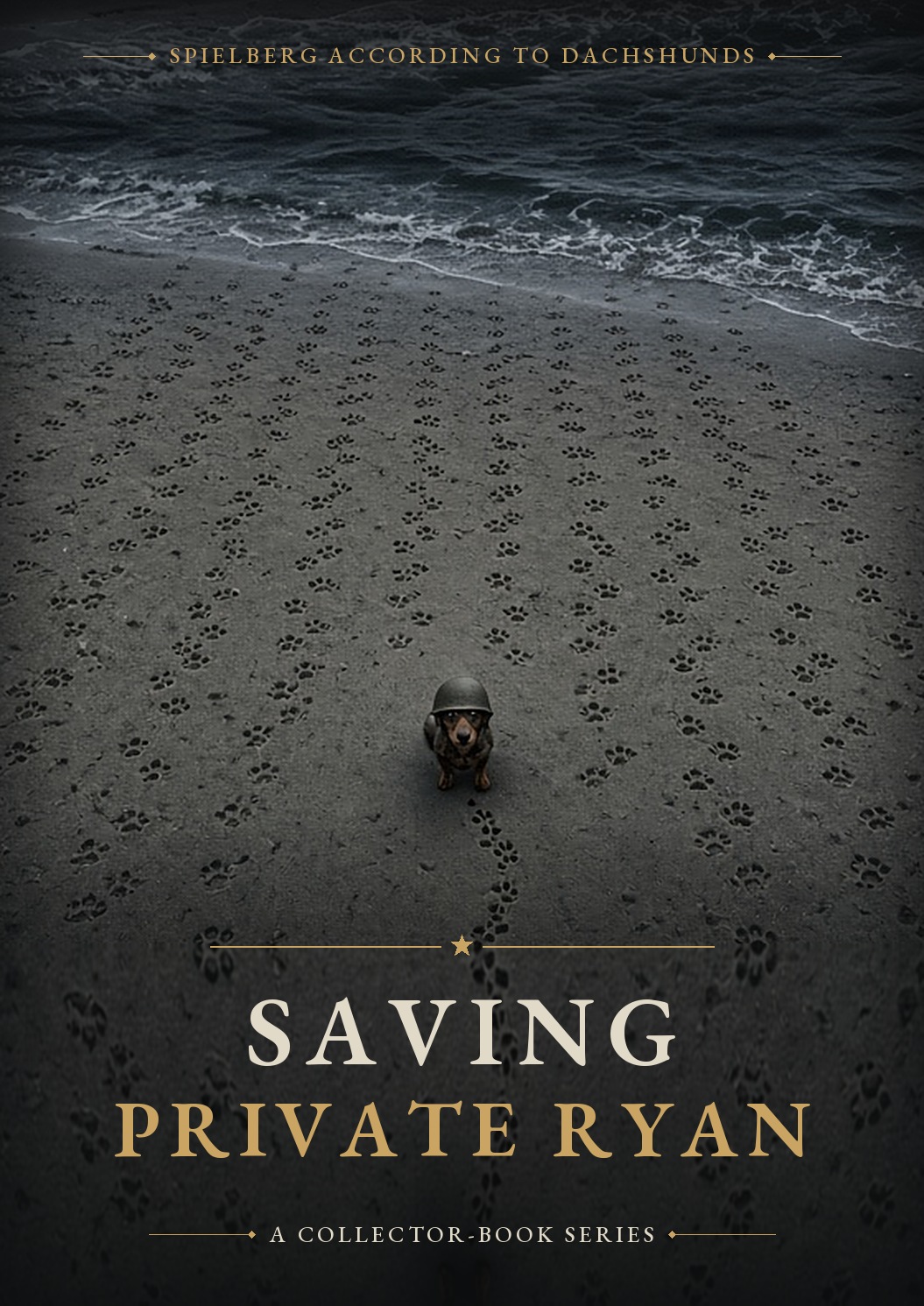
A dachshund rendering must approach such material with humility. The dogs in our image are not a joke imposed upon history. Their scale emphasizes vulnerability: short bodies moving through water, heavy packs carried close to the ground, faces set not in comic bravado but in endurance. The breed’s famous determination becomes, here, something solemn. There is no treat at the end of this beach and no clever caption capable of making the sacrifice light. The only canine inflection is loyalty itself—the instinct to remain with the group when fear provides every reason to turn back.
Released in 1998, the film won five Academy Awards, including directing and cinematography, and profoundly influenced the visual grammar of subsequent war cinema and television. Its legacy is sometimes reduced to the technical force of the opening sequence, but the rest of the film is an extended moral aftershock. Spielberg asks what duty means when orders are clear but justice is not, and what memory owes the dead when history has already moved on. The answer is not hero worship. It is attention.
In a book otherwise filled with rolling tennis balls, alien biscuits and predicted cupboard crimes, Saving Private Ryan creates necessary silence. Spielberg’s career contains both wonder and witness. To honor the second, the dachshunds stand not as comedians but as representatives of the ordinary creature asked to do something larger than its body. Their courage is not that they are unafraid. It is that the water is cold, the shore is far and they continue forward together.
Historical notes: AFI Catalog; American Cinematographer interview with Janusz Kamiński; Academy Awards records.
◆
The preview ends here.
This is the first half of the book. The rest is still at the printer, being sniffed for quality.