Essay
The Badger Was Always Bigger
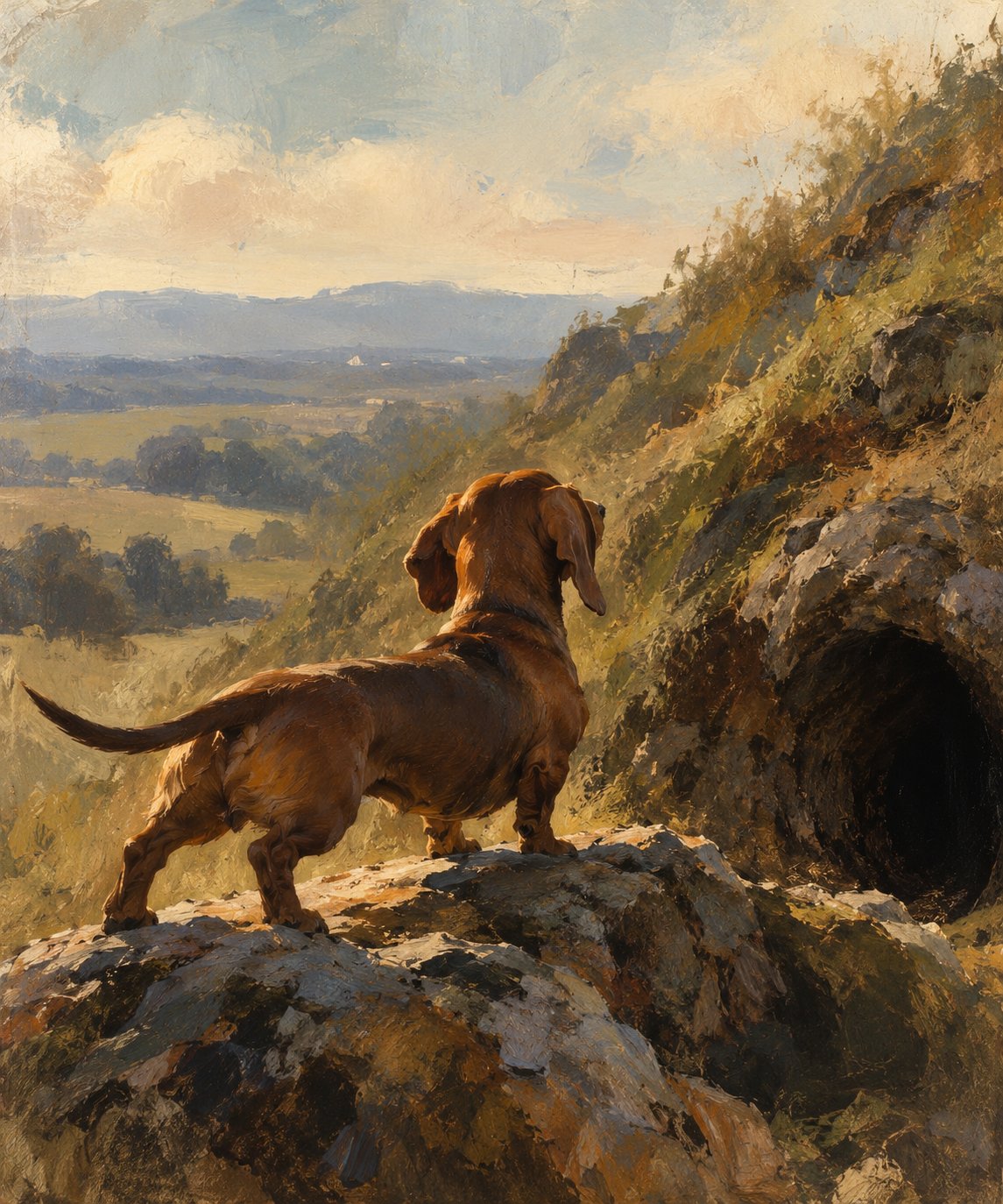
The dachshund is the dog that arrives already funny. Before it has done anything, before it has barked at a delivery van or declined a perfectly reasonable instruction, the shape has made the argument for it. Sausage dog. Wiener dog. A punchline on a lead. Every owner has had the same conversation on the same pavement with a stranger who is very pleased with himself, and every owner has smiled, because the stranger is not wrong about the shape.
He is wrong about the name. Dachs is badger. Hund is dog. The breed was not an accident of fashion or a joke that got out of hand. It was bred, consistently and over centuries, by people with one specific problem, which was how to send something down a hole after an animal that lived at the bottom of it.
It helps to know what that meant. A European badger is a heavy, muscular animal, an adult male commonly somewhere between nine and seventeen kilograms, with front claws built for moving earth. It lives in a sett it dug itself, at the end of tunnels narrow enough that a dog inside them may not be able to turn around. The dog went in alone. Not with the pack, not beside the hunter, not within sight of anyone. Forward, in the dark, toward an animal its own size or larger that had every intention of staying where it was.
Once the job is on the table, the comedy starts to read like a specification. The legs are short because the tunnel is low. The front feet are compact and thick-padded, because the dog often had to dig its own way in. The chest is deep, with a breastbone the American breed standard calls “strongly prominent,” and the ribs are described in language an engineer would recognise: full and oval, “to allow, by its ample capacity, complete development of heart and lungs.” The dog was going to spend a long time working hard in a small space, and somebody wrote the lungs into the paperwork.
Then there is the bark, which is absurd, far too big for the animal producing it. The standard does not apologise for this. It lists a “loud tongue” among the qualities that suit the dog for work below ground, in the same breath as a good nose. A dog that had found its quarry underground was expected to stay there and keep barking, and the people on the surface, holding spades, listened for where the noise was coming from and dug toward it. The volume that now greets the postman was, for most of the breed’s history, the only way anyone knew where the dog was.
And the stubbornness. The famous, exhausting, universally reported stubbornness, the trait every training manual hedges around, the reason the recall is treated as a suggestion. It is the same trait that kept a dog of ten kilograms or so facing a badger in the dark, instead of doing the obvious and sensible thing, which was to leave. None of this describes a novelty dog. It describes a working animal with a genuinely alarming job, and the parts we find ridiculous are precisely the parts that carried the load. The comedy depends entirely on not knowing what they were for.
We do the same thing to each other, and to ourselves more often than to anyone. The colleague who cannot let a thing go, still turning it over three weeks after everyone else has moved on. The one who prepares for a meeting that did not require it. The person who is too loud in a quiet room, or too intense about something small, or who asks the awkward question after the group has visibly agreed to stop asking questions. Read as personality, these are faults, and they get described as faults, usually with a small laugh, in exactly the tone of the stranger on the pavement.
Read as equipment, they are almost always left over. Somebody who cannot let things go was once somewhere that letting go was expensive. Somebody who over-prepares learned it in a room where being caught unprepared cost them something they still remember. The trait was a competence before it was a quirk, and it did not stop being well made just because the tunnel closed.
I want to be careful here, because the cheap version of this thought sits very close by. The cheap version says that once we understand where a trait came from, it stops being a problem. It does not. The dachshund is still difficult to train. Knowing exactly why it ignores the call does not make it come back, and anyone who has stood in a garden at eleven at night, explaining the situation to a dog fully committed to a hole under the fence, knows the explanation changes nothing about the hole. The colleague who cannot let go is still hard to work with. Origin is not absolution, and it does not do the work of change.
What it does is smaller and more useful. It changes what we are looking at. A flaw invites correction. A leftover competence invites a different question, which is what this was built for, and whether anything here is still asking for it. Sometimes nothing is. The person is carrying a full set of tools for a job that ended, and the kind thing is to say so plainly rather than keep calling the tools defects.
And sometimes something is, and nobody noticed, because it arrived in the wrong shape. The person who will not let a thing go is exactly who you want on the problem everyone else has agreed to stop looking at. That is not a consolation. It is a use.
Feedback, a suggestion, or just hello? Write to me at [email protected].
One email when something new goes up. Nothing else.
And a book for your trouble.