The Dogs Were Already There
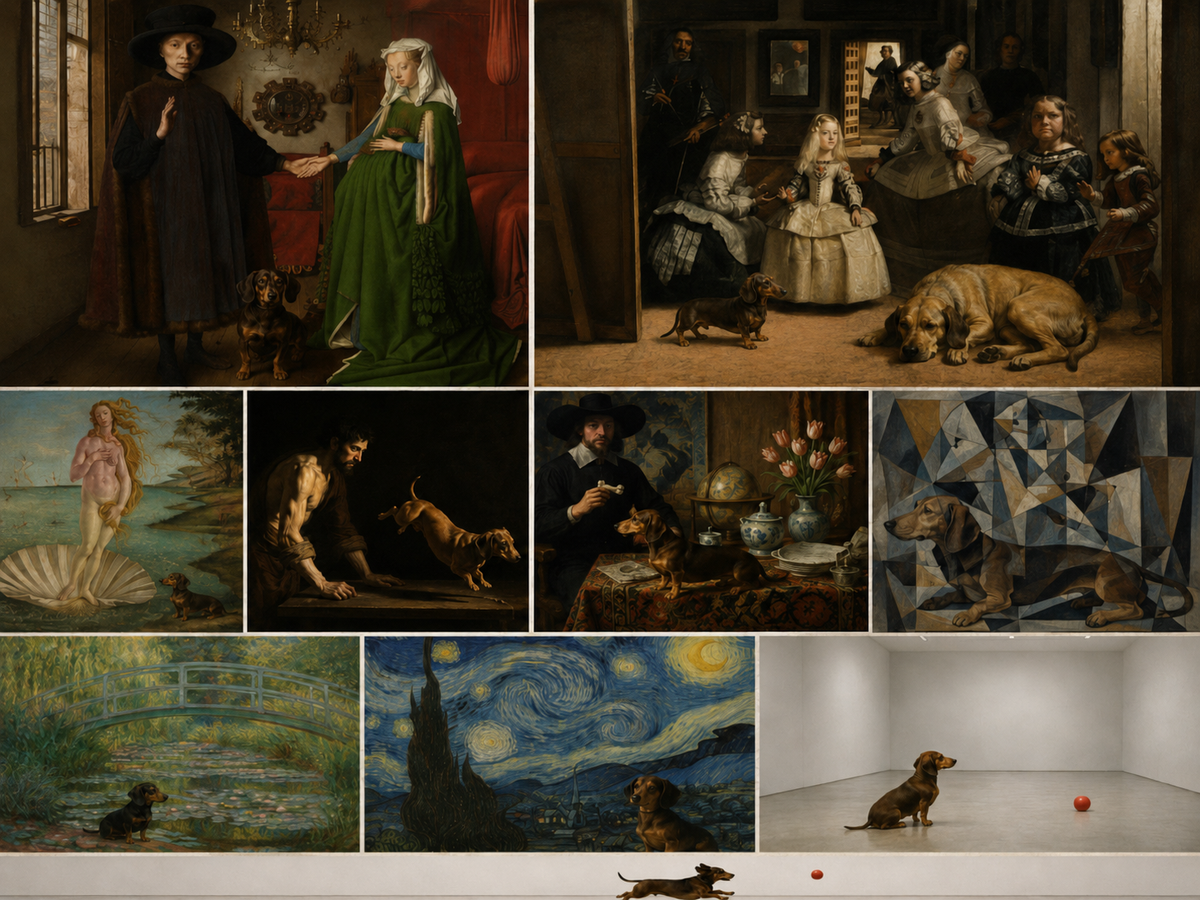
The joke, people assume, is that somebody put a dog into a painting where no dog belongs.
Go and look. Van Eyck put a small dog at the front of the Arnolfini portrait in 1434, staring straight out at the viewer while the couple behind it join hands. Velázquez put a large one asleep in the foreground of Las Meninas, in a room that also contains the King and Queen of Spain, and gave it more floor space than most of the courtiers. For centuries the dog was standard equipment in European painting. It carried fidelity, watchfulness, wealth, ordinary domestic life continuing while something momentous happened at eye level. Almost nobody can now tell you what a single one of them was for.
So the dog was never the intrusion. The dog was there the whole time, doing quiet work at the bottom of the frame, and the history of art walked past it for four hundred years on its way to the important part of the wall.
What if the dog was never the detail?
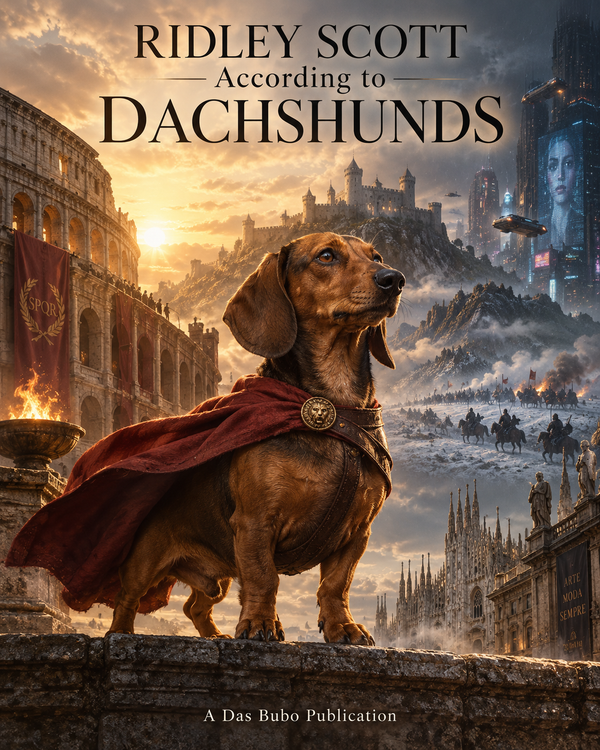
That question is the whole of this book. A Short History of Art, According to Dachshunds takes seventeen movements, from a Renaissance loggia in Tuscany to an empty white room in the late twentieth century, and re-examines each one from the only vantage point art history has consistently refused to occupy. About eight inches above the floor.
The method is straightforward and completely serious. The Renaissance recovered proportion, perspective, and the mathematics of beauty, and the dachshund is a creature that Leonardo's circle and square cannot contain without becoming a rectangle. The Baroque wanted a single shaft of divine light stabbing through total darkness, and there is no more honest subject for that light than a sausage in mid-air. Dutch merchants commissioned portraits to display tulips, globes, Delftware and imported carpets used as tablecloths, and the true masterstroke in the picture is the bone, because everything else could be inherited and the bone had to be earned. Cubism took a creature whose nose, tail, ears and determination already occupy different dimensions and finally gave it a style that fit.
None of that is mockery. It only works because the originals are still doing what they were built to do. Every parody is a confession that the thing being copied still has power, and you cannot write four hundred words about tenebrism as a joke without having looked at a great deal of tenebrism first. The book is far more interested in getting you to notice Caravaggio's light again than in getting a laugh out of it, and the laugh is mostly a side effect of the noticing.
There's one page near the end with almost nothing on it. A white gallery, a small dog, a red ball on the floor that has not been thrown. It's the minimalism entry, and it's the only one in the book whose caption doesn't reach for a joke, because it doesn't need one.
If you've ever lived with a dog, you already know exactly how long that room has been waiting.
Everything else in the book is about art. That page is about hope, which is a smaller and much harder subject, and it turns out a dachshund can carry it.
The ball gets thrown. It's on the last page.
M.