
The Pile
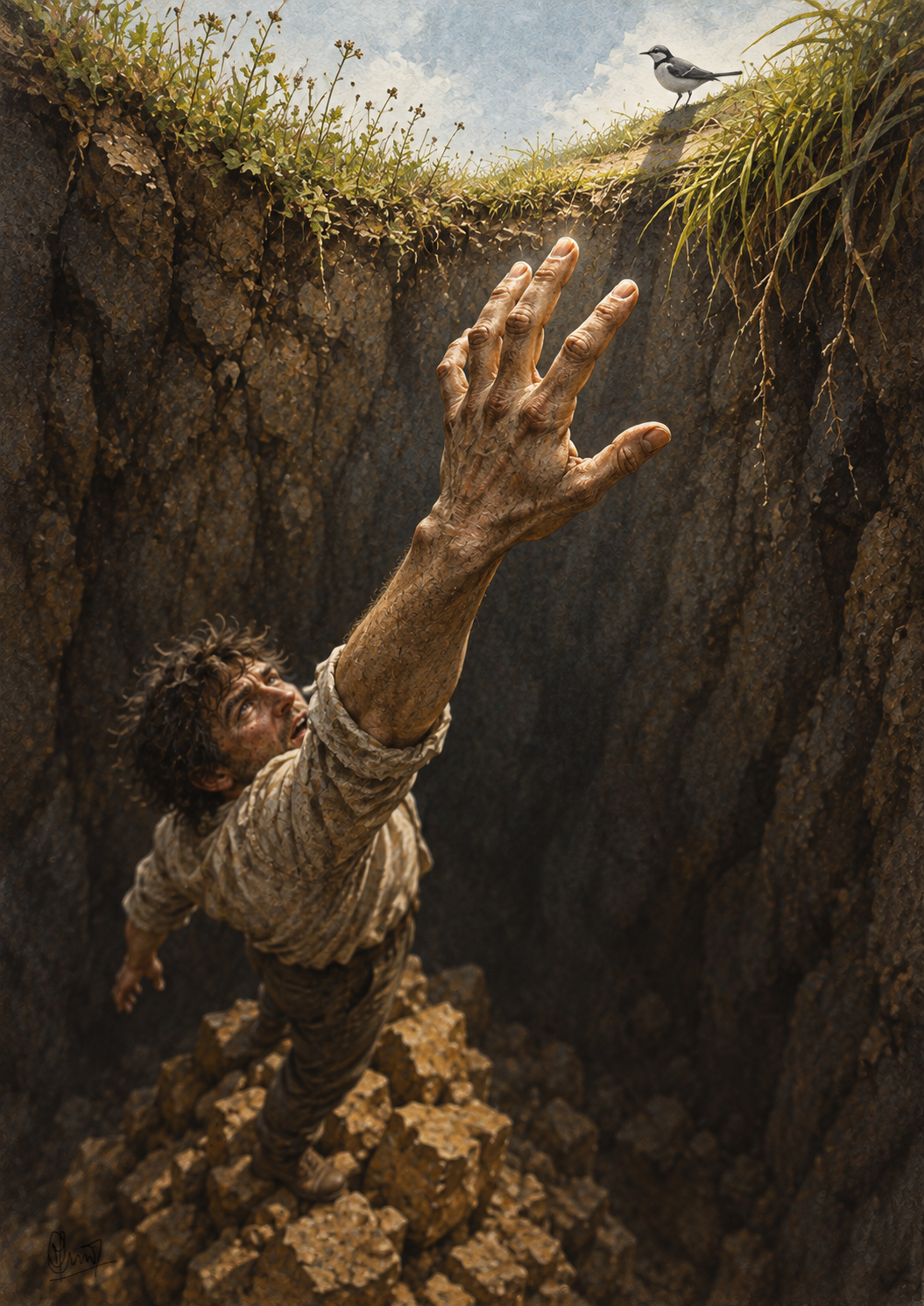
There was a man, and the man had a dream. He dreamt of an edge that was out of reach.
The man could see the edge. That was the whole difficulty. A chasm with no visible rim is a cave, and a man in a cave makes his peace with darkness. But the edge was there, a clean line with sky behind it, near enough that he could count the blades of grass leaning over it, far enough that his fingers, at full stretch, closed on nothing.
He decided to build. There were no loose stones at the bottom, so he knelt and pulled them out of the floor, and the floor gave them up easily, the way bread gives up its crust. The stones were warm. He set stone on stone. The pile rose.
Each evening he climbed the pile and reached. Each evening his fingers closed on nothing. Then he climbed down and dug.
He was not a stupid man. He kept accounts. Sometime in the third year the accounts began to trouble him, because the pile stood taller than two of him and the reach had not changed by a hand’s width. So he measured. He measured the pile, and he measured the hole the stones had come from, and the numbers were the same. He wrote the number down.
It was his age.
He stood between the hole and the pile with the measuring cord in his hands for a long time.
In the morning he chose an explanation. The floor was soft. The pile was settling. The fault was in the stones, not the arithmetic. And it was true that the stones had begun to soften. The lowest ones took the shape of the ones above them, like wax near a lamp, and the pile leaned and held. He knelt and dug, and the work went well.
He came to know the edge better than he knew his own hands. The grass up there was of two kinds. Rain arrived at the rim a full breath before it arrived at the bottom, and some days it never arrived at all but hung halfway down, a grey shelf he could have walked on if the pile had been a little taller. His palms split and closed and split again. Once a bird stood on the exact lip for most of an afternoon, throwing a shadow so long it reached the floor beside him, and he did not dig at all that day, and considered it the finest day of the work.
Later, though there was no way to tell how much later, the walls began to lean in over him like people at a bedside. The sky narrowed to the width of the rim. One evening he climbed the soft pile and reached, as he always reached, and his fingers closed on grass. It was cool, and of both kinds.
The man woke in a low room where everything was within reach. The lamp. The shelf. The edge of the table. The ceiling, if he stood on the bed. His heart was going hard.
He lay very still until morning, and did not touch any of them.
M.