The Unnamed Hands
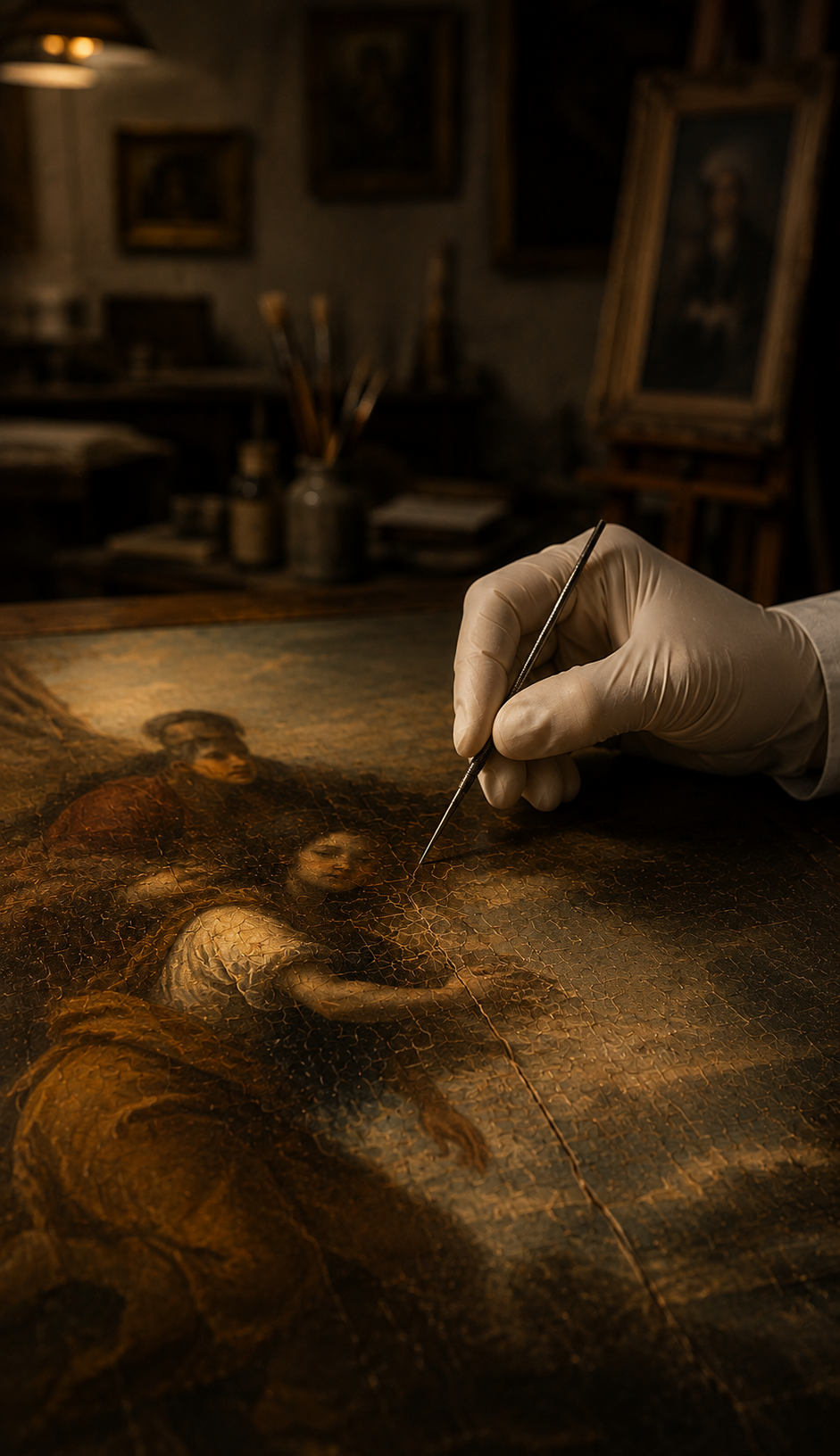
There is a particular kind of silence in museums that I have always liked. It is not really silence. There are footsteps, distant conversations, someone explaining a painting to another person. But the quiet seems to belong to the objects themselves.
A canvas may have survived war, fire, humidity, neglect, careless transport, poor restoration and several centuries of human history. We remember the person who painted it. Their name sits beside the work on a small card. We almost never know the names of the people who kept it alive. The conservator who noticed the first crack in the paint. The person who controlled the humidity in a room. The technician who built a container for a journey across an ocean. The curator who decided that doing less was safer than doing more. Someone placed a hand beneath something fragile and made sure it reached the next generation, and their work is invisible precisely because, when it succeeds, nothing dramatic happens. The painting simply arrives.
I have thought about this more often since working in organ transplantation. Our vocabulary is understandably technical. We speak of ischemia, preservation time, perfusion, viability, graft function and survival. These words are necessary. They let us measure, compare, improve and hold ourselves accountable. But sometimes they conceal something simpler, which is that for a brief period of time something extraordinarily precious has been entrusted to us.
Between donation and transplantation there is an interval that few people outside our world ever see. It can last hours. It can cross cities, states or countries, and it can involve operating rooms, laboratories, vehicles, aircraft, machines, telephone calls and decisions made in the middle of the night. Everywhere along that journey there are hands, and most of the people they belong to will never be known to the person who receives the organ.
Medicine tends to remember its visible moments. The operation is visible. The surgeon is visible. The recovery of the recipient is visible, and so is the photograph of someone returning home, holding a child, climbing a mountain, or simply sitting again at the family table. Preservation is different.
Preservation lives in the space before the photograph.
For most of its history, preservation meant slowing biology. Cooling reduced metabolism and bought time, and that was enough to make modern transplantation possible. What has changed is that the interval is no longer only a delay. An organ outside the body can now be perfused and to some extent watched, and the language has followed, from preservation toward assessment and recovery and repair. How much those observations finally tell us about any particular organ is still being learned, and it is worth saying so plainly while the field is moving quickly.
The change should make us ambitious, and I sometimes wonder whether our fascination with what the technology can do distracts us from why we are doing it. A machine can measure, circulate, oxygenate and preserve. It cannot understand what has been entrusted to it. We must. An organ is not tissue moving through a healthcare system. It carries the final generosity of another human being. Somewhere a family is living through a day they will remember for the rest of their lives, and somewhere else a telephone may ring and divide another life into a before and an after. The purpose of preservation is not to make an organ last longer because longer is better. It is to protect the possibility that a gift reaches the person who needs it.
This is why the analogy with conservation holds. A good conservator does not try to become the artist. The task is not to improve Rembrandt, or to leave evidence of one's own brilliance on a canvas. It is more restrained and more demanding. Understand what is in front of you. Recognize its vulnerability. Intervene when intervention is needed. Protect what has been entrusted to you. The better our tools become, the easier it is to forget that this remains at the center of the job.
There is another reason I return to museums. Occasionally I stand in front of a painting four or five hundred years old and think about the improbable chain of people required for me to be able to see it. Most of them are gone. There is no plaque for the person who carried it away from a fire, or noticed the first sign of deterioration, or repaired a damaged frame, or decided where it should be kept during a war. Yet somewhere in the survival of that object are all of them.
Transplantation has its own unnamed hands. Someone spoke gently to a family. Someone remained beside a donor through the night. Someone checked a temperature one more time. Someone noticed that something was not quite right. Someone drove. Someone solved a problem the recipient will never know existed. If all of those hands have done their work, the organ arrives, the transplant happens, and a life continues.
Perhaps that is one of the quietest forms of accomplishment in medicine. To have been part of something extraordinary and to leave almost no trace of yourself behind, except that it survived.
The label credits the painter. The painting is there because of someone else.
M.