A Place To Land
There is a sentence we say to people who are suffering, and we say it with the best of intentions. We say it at funerals, at hospital doors, to children who fall, to adults getting divorced, to the one who lost the job, to the one who lost someone. Be strong. Hold on. You have to be strong now, more than ever. It sounds like advice, and that is how we receive it, as an instruction for what to do next. It isn't advice. It's a request. It asks the person in the middle of the pain to take care of us, not to frighten us, to keep their face composed long enough that ours can stay composed too. Whoever says "be strong" is almost always asking not to have to hold anything.
Anyone who has worked in intensive care knows the other side of that sentence. They know the corridor at three in the morning, the family standing by the coffee machine, the question nobody asks because they already know the answer. And they know what happens when a nurse, or a doctor, or very often just the woman who cleans the floors, walks over and says nothing useful at all. Puts a hand on a shoulder. Stays there. Thirty seconds, a minute, however long it takes. Nothing is solved in those minutes, nothing is explained, nothing is promised. And yet they are often the only moment of that night the family remembers ten years later. Not the conversation with the doctor. The hand.
A hug asks nothing. It answers nothing either. That is why it works.
We are bad at accepting this. We were taught to value what solves, what produces, what closes the matter, and a hug closes nothing. The problems stay exactly where they were. The debt is still there, the diagnosis is still there, the distance is still there. So we treat the hug as a minor gesture, a kind thing you do before getting back to the real work. And yet the body knows something the head refuses to learn. There is a difference between a problem carried alone and the same problem carried for one minute with someone standing beside you. The weight is the same. The person carrying it is not.
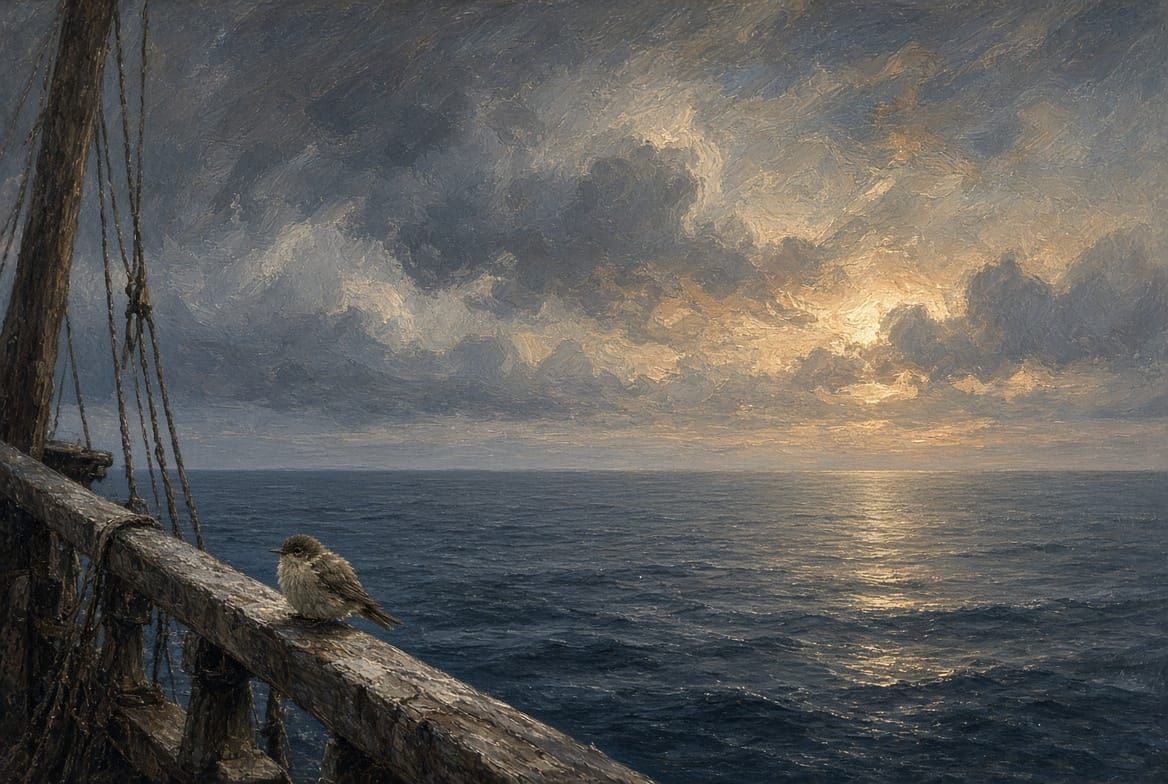
Sailors know a phenomenon that helps with this. In the middle of the Atlantic, hundreds of miles from any coast, birds sometimes appear on deck. Small ones, land birds, with no business being out at sea. They are migrating birds that drifted off course, or ran into a headwind, and have now been flying for more hours than a body can stand. They land on the ship because it is the only surface there is. They don't ask where the ship is going. It doesn't matter to them. They stay an hour, an afternoon, a night, hiding from no one, so tired they let themselves be looked at up close. And then, when the body has recovered what it needs, they lift off and go back to their own lives, which were never the ship's.
The ship does not save them. It doesn't take them anywhere, doesn't correct their course, doesn't feed them. It offers a place to land for exactly as long as landing is the only thing that matters. It's very little, and for the bird it is everything.
We spend years looking for the harbour, and yet what most of us need, on most days, is the deck. Not the solution. Not the place where everything is finally resolved. A firm surface for an hour, no questions asked, before going back into the wind. Life is a whirlpool that stops for no one, and the strength we are asked for was never meant to beat the whirlpool. Nobody beats it. It is meant to keep us inside it looking like we're fine. What we lack is not more strength. It is a place to land between one turn and the next.
And here is the part nobody says at funerals. The places where we land are not always close. Some of them ended up on the far side of choices we made at twenty, choices that seemed small at the time and turned, without warning, into whole lives. One city instead of another. A degree, a job, a marriage, children who grew up and are now adults with lives of their own. One life stayed on one side of the ocean and the other on the other, and the two ran in parallel for decades, each knowing very little about the other. There was no falling out. There was only distance doing what distance does, which is to keep accumulating.
What distance does not do is erase the deck. There are people who go on being a place to land even after twenty or thirty years of our not landing on them. You know this in a strange way, without proof, the way the bird knows that surface will hold. And sometimes life hands one of those people back to us by a route nobody drew. Someone, on the other side of the sea, comes across a few pages we wrote and reads them all, one after another, in a single night. And on the other side of those pages there is someone who, on learning it, feels something that has no name in any of the languages he has learned to speak. It isn't saudade, which is a word for those who wait. It is closer to what the bird must feel when it sees the ship: the body recognising, before the head does, that here it can land.
A hug sent through a screen is a diminished thing. It has no arms, no weight, no smell of the person giving it. It would be easy to dismiss. But there comes a point in life, and you reach it somewhere around fifty, when you understand that nearly everything good we get arrives diminished, by crooked roads, late and incomplete, and that the alternative is not the whole version. The alternative is nothing. A hug through a screen, from someone who knows exactly which hug is meant, is not an imitation of the real one. It is the real one crossing the only surface that exists between two lives, and arriving.
If you are reading this from far away, and tired of being strong, there are no questions here. There are no answers. There is nothing to solve, and nobody will ask you to look after anyone else for as long as you stay. Stay as long as you need. The sea is still out there, and so is your life, and neither of them needs you this hour.
The ship does not ask the bird where it is going. It lets it stay.
M.