
Unfinished
The line is everywhere. On posters, in commencement speeches, printed over photographs of white marble: "I saw the angel in the marble and carved until I set him free." It is attributed to Michelangelo with total confidence, and it carries a complete philosophy of making things, and of being someone. The figure is already in there. Your job is to remove what hides it. Nobody has ever found the line in anything he wrote.
What he did write is a sonnet, and the sonnet is stranger and more honest. The best artist has no conception, it says, that a single block of marble does not already hold inside its excess, and only the hand that obeys the intellect will reach it. The posters stop there. The poem does not. It turns, and what it turns into is a confession of failure, his own, a man standing in front of what he loves and able to draw nothing out of it but his own death. The famous version promises the angel. The real version promises only the reaching, and it was written by someone complaining that his reach fell short.
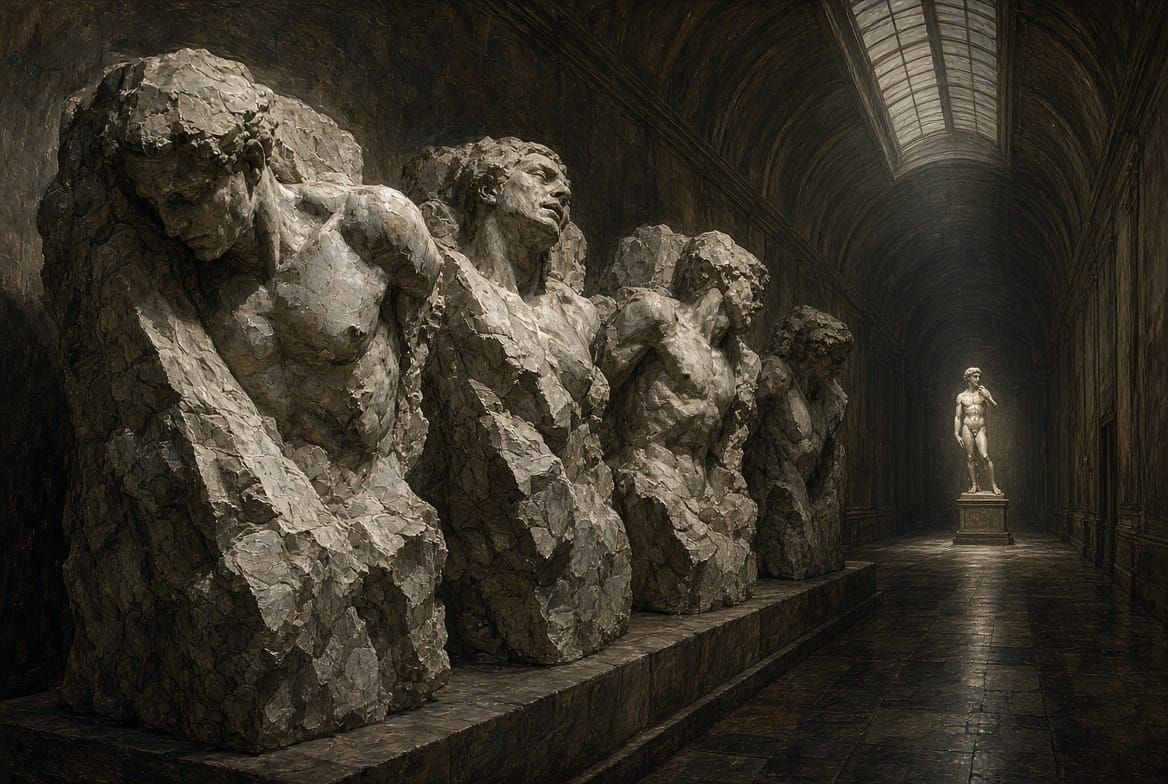
You can test the two versions against each other in a single hallway in Florence. In the Galleria dell'Accademia, everyone walks toward the David. The corridor is built for that walk: the finished masterpiece stands at the far end under its skylight, white and resolved, and the crowd moves toward it like a current. But the corridor itself belongs to four other figures, the ones called the Prisoners, and the received line prepares you very badly for them. It tells you that you will see figures being liberated, souls emerging from stone on their way to completion. That is not what is there. What is there is arrest. A torso twists out of raw rock and stops. A face is half born and stops. The chisel marks are still legible, the rough passes and the finer ones, the whole grammar of a working day interrupted. Standing in front of them, it is not lesser for it. Some of us stand longer in front of the Prisoners than in front of the David.
Further down the same hall is a St. Matthew, the only one of twelve apostles Michelangelo ever began under a contract signed in 1503. He roughed it out and left it when he went to Rome. Nobody has touched it since. It has been standing there mid-sentence for five hundred years, and the room has arranged itself around it as though that were a perfectly ordinary condition for a thing to be in, which it is.
The history behind the Prisoners is not romantic. They were carved for the tomb of Pope Julius II, a commission that began in 1505 as the grandest sculptural project of the age and then shrank, contract by contract, across four decades. Julius had been dead for years by the time these four were begun, so his death is not the reason they stopped. What stopped them was smaller and more familiar: a contract renegotiated downward by the family's heirs, the figures dropped from the design, and a move to Rome for other work. After his death they ended up in a garden grotto in Florence, standing in the damp as scenery for three centuries, and only reached the Accademia in 1909. And scholars still argue about the stopping itself. Some read the unfinished state as intention, a deliberate aesthetic, the non finito. Others read it as circumstance, a man buried under obligations who never got back to them. Most unfinished things do not have one reason.
Science made its peace with this long ago. Every paper ends the same way, with some version of "further research is needed," a ritual sentence that is easy to mock and is actually the whole ethic of the enterprise stated in four words. We announced the human genome complete in 2003. About eight percent of it was still unread, the hardest and most repetitive regions, and it took until March 2022 for the Telomere-to-Telomere consortium to publish a sequence with no gaps. Even that one is a single cell line, one instance of the thing, and not a typical one. The 2003 announcement was not a lie. It was a stopping point that held, a torso good enough to work from, and that is what most finished things in science turn out to be up close.
I work in transplant, so I see this in a more concrete form. When we draw a survival curve, the line steps downward at every death, and along it sit small vertical ticks that most eyes slide past. Each tick is a censored patient: someone still alive the last time the study saw them, someone whose story it did not get to finish. Some of them reached the end of follow-up. Some moved, or withdrew, or simply stopped coming, and the study has no idea what happened next and says so. The curve does not pretend to know how those stories end. It marks, precisely, the boundary of what was seen. The most rigorous thing on the page is that little admission. The method is honest the way the corridor is honest. It shows you where the hand stopped.
We tell the angel story about our lives, too, and that is where it does its real damage. Your true figure is in there, the story goes, waiting in the stone. Find the calling, free the shape, and at the end of the corridor stands the completed self, lit from above. It is a beautiful story, and it quietly converts everything unfinished into evidence of failure. The degree never used. The language half learned. The specialty trained for and left. The book stopped at chapter three. The friendship that trailed off mid-sentence. If the figure was always in there waiting, then every abandoned block is an angel you failed.
But what if a life is more like the corridor than the statue at the end of it?
Look again at what the Prisoners actually are. They are not failures of the David. They are the same hand, the same years, the same intelligence, met by different weather. Nobody walks that hallway thinking less of the man because four of his figures never came free. The chisel marks that were once evidence of interruption are now the thing people lean in to see, because they show something the polished surface conceals, which is how the work was actually done. The unfinished is not the opposite of the achieved. It is the record of reach, kept in the only material that does not flatter.
Michelangelo, late in life, was asked to settle the old argument about whether painting or sculpture was the greater art, and gave an answer with no angels in it at all. Sculpture, he wrote, is the art made by taking away. He meant it as a technical distinction. It reads now as something larger. Not the freeing of what waits inside, just the patient removal of what is in front of the hand today. That is a workable definition of a life too, and a kinder one than the poster. You do not get the promise of the figure. You get the stone, the tools, the hour, and the obligation of the hand that obeys. Some blocks will come all the way through. Most will not, and the ones that stop mid-sentence still count, still stand, are still worth the walk down the corridor.
Not the angel. The reaching.
M.